 In September 2000, Caltech’s Institute for Quantum Information and Matter (IQIM) was born (albeit with a different name, the Institute for Quantum Information, or IQI). At the time, it was one of the world’s first centers dedicated to the study of quantum information science—a field that uses the laws of quantum physics to create better computers, sensors, and other probes for studying fundamental physics. Decades earlier, Caltech researchers foresaw that quantum information sciencewould gain momentum, most notably the late Richard Feynman, who was the first to realize that solving the hardest quantum physics problems would require quantum machines.
IQIM, which is funded by the National Science Foundation (NSF), grew out of IQI and in 2011 became IQIM, an NSF Physics Frontiers Center at the leading edge of both theoretical and experimental studies in quantum information science
What did the shift from IQI to IQIM mean for the organization?
Having IQIM was really helpful for recruiting people, students, and postdocs, but also faculty. If you look at the faculty who are involved in quantum science on campus today, a lot of them were hired beginning in 2012, starting with the first six-year cycle of IQIM. Of course, faculty hiring is not directly tied to a federal grant, but the fact that we had this coherent center that cut across Caltech was very helpful for recruiting great people.
We also became highly interdisciplinary, with ties to physics, applied physics, computer science, electrical engineering, chemistry, and materials science. An important part of our vision is making deep connections between these different areas.
What kinds of science problems has IQIM been specifically addressing?
In general, we want to achieve better control of quantum systems. We are thinking about how to use entanglement to do interesting things like encrypted communications or more sensitive measurements, for example. And we use these tools to characterize complex phases of matter and their entanglement structure, and to illuminate how the phases of matter can be distinguished from one another. Our research has connections to quantum gravity, too [the attempt to unify quantum physics with general relativity]. Students who are studying quantum gravity now need to be well informed about ideas in quantum information. That wasn’t true when IQIM began. Topics ingrained in the bones of computer scientists became of direct interest to the fundamental physicists.
Of course, how to actually build a quantum computer is at the forefront of a lot of our work, both theoretical and experimental. That spawned the creation of the AWS Center for Quantum Computing on campus, which is led by IQIM faculty members. Quantum hardware is plagued by frequent errors, so a key challenge is understanding how to make quantum computers reliable despite the faulty hardware. Just as important is understanding how quantum computers can be used to advance science and benefit society.
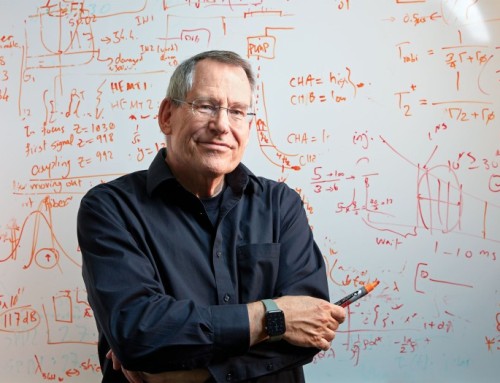
John Preskill

Read the full Caltech Media story here: Caltech’s Pioneering Quantum Hub Celebrates 25 Years