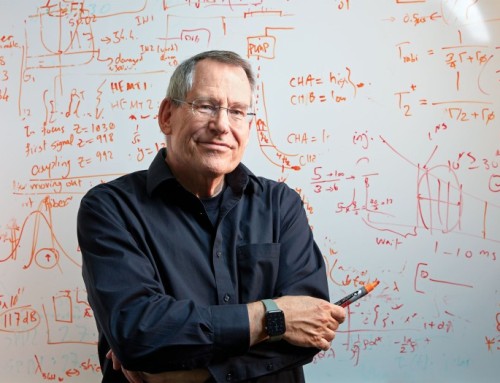
An IQIM collaboration between the Endres group and Alicea group, working with theorists at Université Paris-Saclay and the Technical University of Munich, performed first-of-their-kind experiments on two different conformal field theories using quantum simulators.
 Using new technology developed for these quantum simulators, the team reports the first direct measurement of energy levels in synthetic quantum matter as predicted by the Ising and tricritical Ising conformal field theories. (Ising refers to Ernst Ising, a physicist who, in the 1920s, solved an early model of magnetism.) Both theories describe universal behavior that emerges when a quantum system—exhibiting exotic traits such as entanglement and superposition—is placed at a tipping point between two states, one of which is more ordered than the other.
When different materials transition from one phase to another, such as water coming to a boil or a magnet losing its ability to attract metals, something remarkable can happen: They begin to behave identically, following the same mathematical rules. “Physicists call this trait universality—the messy, microscopic details wash out and only a few essential features survive,” explains Jason Alicea, William K. Davis Professor of Theoretical Physics. The math underlying these universal traits is commonly described by a theoretical framework called conformal field theory.
For four decades, researchers used conformal field theories to calculate the spacings between those rungs, which come in precise ratios, but nobody had measured them in an experiment until now.
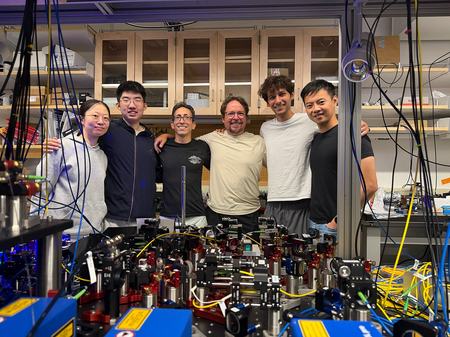
Left to right: Yuan Le, Xiangkai Sun, Jason Alicea, Manuel Endres, Stephen Naus, and Richard Bing-Shiun Tsai in the Endres lab at Caltech.
“Our new tools borrow from quantum computing platforms,” says Xiangkai Sun, a co-lead author of the new study and a graduate student working in the Endres lab. “Over the past 10 years, people have been learning to control these systems, and now we are at the point where we can use them to do fundamental physics research.”
For the experiment, the researchers used optical tweezers to trap strontium atoms in a line. They used other lasers to excite the atoms into high-energy states called Rydberg states, which makes neighboring atoms interact strongly. The chain of atoms then behaved as a single entity rather than as independent particles. Next, the researchers tuned the lasers in a way that placed the chain at the tipping point.
Read more in the Caltech Media story Universal Pattern Revealed in Quantum Matter
Read the Nature article Xiangkai Sun, Yuan Le, Stephen Naus, Richard Bing-Shiun Tsai, Lewis R. B. Picard, Sara Murciano, Michael Knap, Jason Alicea & Manuel Endres, Observation of conformal field theory spectra in a quantum simulator Nature (2026). https://doi.org/10.1038/s41586-026-10904-x