Quantum computers of the future may be closer to reality thanks to new research from Caltech and Oratomic, a Caltech-linked start-up company. Theorists and experimentalists teamed up to develop a new approach for reducing the errors that riddle today’s rudimentary quantum computers. Whereas these machines were previously thought to require millions of qubits to work properly (qubits being the quantum equivalent to 1’s and 0’s in classical computers), the new results indicate that a fully realized quantum computer could be built with as few as 10,000 to 20,000 qubits. The need for fewer qubits means that quantum computers could, in theory, be operational by the end of the decade.
The team proposes a new quantum error-correction architecture that is significantly more efficient than previous approaches. Quantum error correction is a process by which extra, redundant qubits are introduced to correct errors, o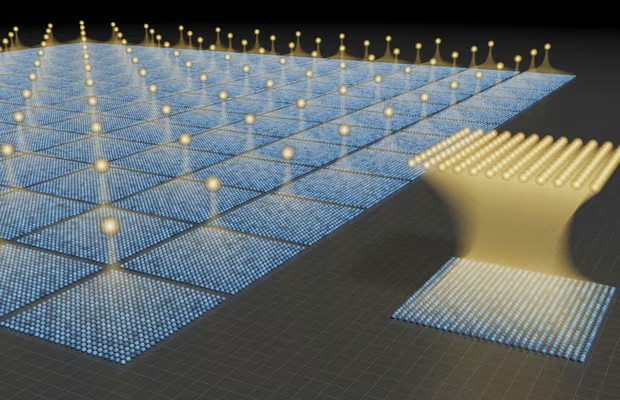 r faults, enabling the ultimate goal in the field: fault-tolerant quantum computing.
“Fault-tolerant quantum computing with neutral atoms is a rapidly emerging topic, and it was clear there are many understudied opportunities for finding shortcuts,” Bluvstein says. “We gathered some of the world’s top experts in the topic at Caltech to put all the pieces together. What we came up with—a clear road map to building a quantum computer—came faster than we expected.”
The next steps are to take larger arrays like those of Endres and his group and scale them up to even larger numbers while demonstrating low error rates, a process that will require additional technological advances.
Read the full Caltech Media story Caltech Team Finds Useful Quantum Computers Could Be Built with as Few as 10,000 Qubits and the paper: Shor’s algorithm is possible with as few as 10,000 reconfigurable atomic qubits, Madelyn Cain, Qian Xu, Robbie King, Lewis R. B. Picard, Harry Levine, Manuel Endres, John Preskill, Hsin-Yuan Huang, Dolev Bluvstein, https://doi.org/10.48550/arXiv.2603.28627