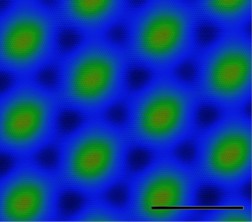
Atomically resolved image of twisted-trilayer graphene obtained by scanning tunneling microscope.Scale bar 10nm. Credit: Nadj-Perge Lab.
Magic-angle graphene hosts robust unconventional superconductivity, yet its underlying mechanism has remained elusive despite years of investigation. A new study from IQIM researchers establishes that magic-angle twisted trilayer graphene becomes superconducting only after passing through a sequence of distinct correlated states.
Using a low-temperature scanning tunneling microscope (STM), the team of Prof. Stevan Nadj-Perge tracked how electronic states evolve as they cooled the sample and tuned the carrier density. They found that, before superconductivity sets in, electrons first form a “heavy” state in which they move sluggishly but in a highly coordinated fashion, reminiscent of heavy-fermion metals. In this regime, a sharp peak in the electronic spectrum appears at the Fermi level—the boundary between filled and empty states—and remains pinned there over a range of doping, signaling a many-body resonance rather than a simple band feature. Upon further cooling, electrons in different valleys of graphene’s electronic bands lock together and form an ordered pattern in real space, producing an intervalley-coherent phase.
At still lower temperatures, when the system enters the superconducting regime, the spectra reveal two distinct gaps at the Fermi level. “The smaller ‘inner’ gap is fragile, disappearing at the same magnetic field and temperature as the signatures of superconductivity measured by point-contact spectroscopy that detects Andreev reflection, a process where electrons are converted into Cooper pairs. The larger ‘outer’ gap persists to higher temperatures and fields and closely tracks the presence and strength of the intervalley-coherent order, indicating that superconductivity emerges on top of this correlated background. “Resolving these two gaps took a lot of effort and years of perfecting the sample quality,” says Nadj-Perge. “When we observed two gaps for the first time, we were very excited, as this observation cleared up several mysteries in the field. Our results suggest a specific hierarchy of phase transitions in twisted trilayer graphene and bring us closer to understanding superconductivity in this material.”
The study was led by former IQIM graduate student Dr. Hyunjin Kim and, in addition to the Caltech team, involved scientists from Princeton University, UC Santa Barbara, University of Hamburg and University of Würzburg in Germany, and the National Institute for Materials Science in Japan.
Read the full article: H. Kim et al, Resolving intervalley gaps and many-body resonances in moiré superconductors, Nature (February 4, 2026).